
Three Eras, One Framework, Infinite Opportunity
How Ford, Google, and Your Company Can Dominate Through Integrated Transformation
"History doesn't repeat itself, but it often rhymes." - Mark Twain
Executive Summary
Every industrial revolution creates an extraordinary window of opportunity. New technologies emerge that fundamentally reshape how businesses operate, compete, and create value. But here's the pattern that history reveals: companies that simply adopt new technologies see modest improvements—perhaps 5-10% gains. Companies that reimagine their entire business model around new capabilities achieve order-of-magnitude advantages—40-50% productivity improvements, dominant market positions, and sustainable competitive moats that last decades.
This document examines three companies across three revolutions, revealing the systematic pattern behind transformational success:
Ford Motor Company didn't just replace steam engines with electric motors. They reimagined manufacturing completely—inventing the moving assembly line, redesigning factory layouts, and creating vertical integration. The result: 55% market share, 24-fold revenue growth in one decade, and competitive advantages that defined the automotive industry for generations.
Google didn't just build a better search engine. They created an integrated platform ecosystem with advertising, cloud computing, mobile operating systems, and artificial intelligence. The result: $2 trillion market capitalization, 90% search market share, and seven distinct sources of competitive advantage that competitors struggle to replicate.
Your company can replicate this pattern in today's digital revolution. Artificial intelligence, cloud computing, automation, and data analytics aren't just tools for incremental improvement—they're the foundation for comprehensive business transformation. The companies that understand this will dominate their industries for the next 20 years. The companies that don't will be disrupted by competitors who do.
The Fusion Framework provides the systematic methodology these winners applied—whether they knew it explicitly or discovered it intuitively. By working through six integrated elements (Forces, Understand, Strategy, Innovation, Operations, Network), organizations transform technological disruption from existential threat into extraordinary competitive advantage.
The difference between winners and laggards isn't resources, technology access, or market position. It's systematic approach to integrated transformation. This document shows you the pattern, the framework, and the path forward.
Transformation at a Glance: Three Eras, One Pattern
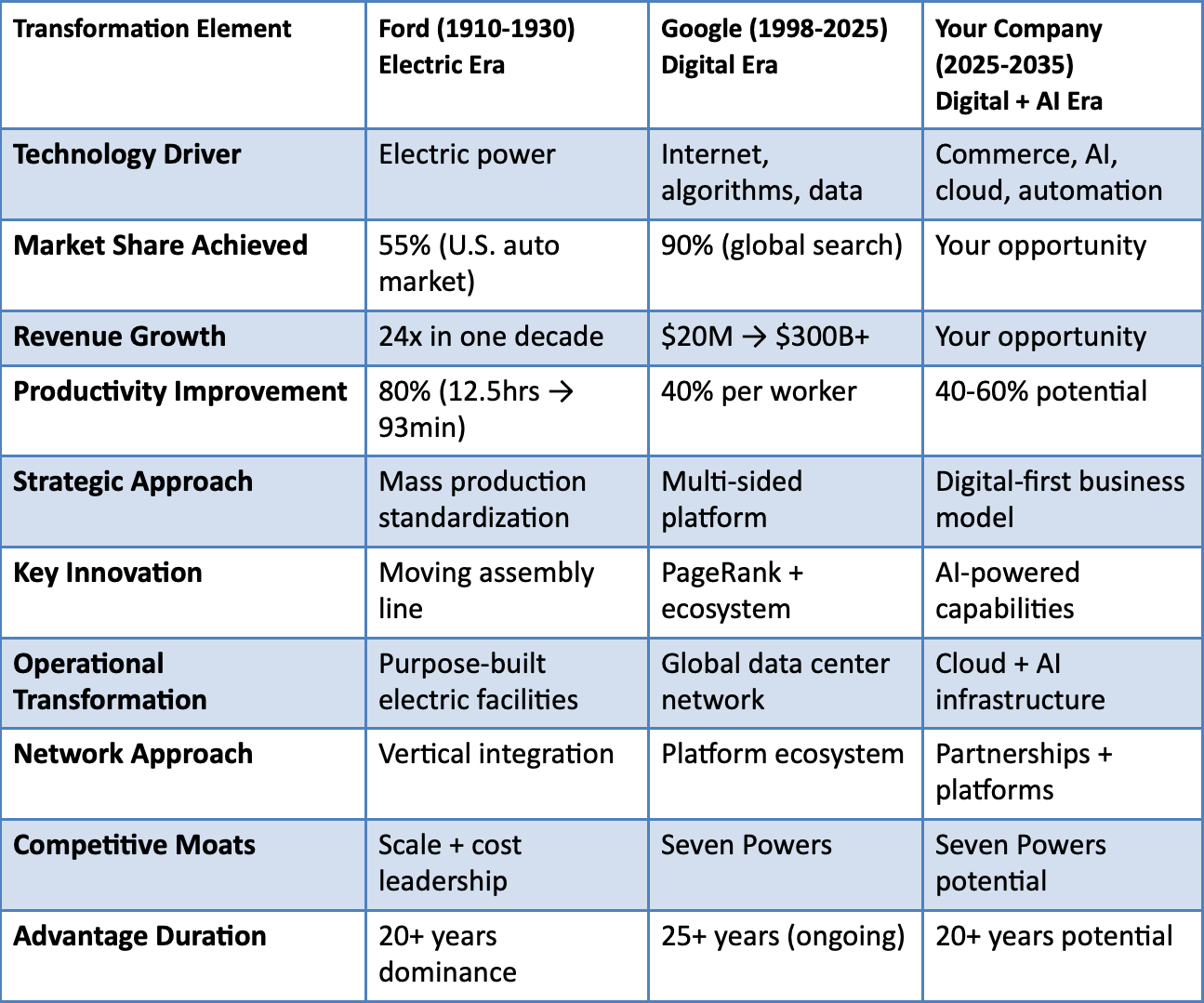
Key Insight: Integrated transformation creates 40-50% improvements versus 5-10% from technology adoption alone. The pattern repeats across eras.
PAST: Ford Motor Company (1910-1930)
The Challenge
Automobiles were luxury items. Production took 12.5 hours per vehicle. Ford envisioned affordable transportation for average Americans. Achieving this required complete transformation, not incremental improvement.
The Fusion Framework in Action
Forces: Electric power offered flexibility impossible with steam—individual motors, precision control, flexible layouts. Rising labor costs pressured productivity. Untapped middle-class demand existed if prices dropped dramatically.
Understand: Electric power enabled inverting production—products move, workers stay stationary. This meant: lower production time → lower costs → lower prices → mass demand → greater scale → lower costs. A self-reinforcing cycle.
Strategy: Total standardization. Massive capital investment in purpose-built facilities. Vertical integration controlling the entire supply chain. Volume-driven profitability—maximize total profit, not profit per unit.
Innovation: Moving assembly line (1913) cut production from 12.5 hours to 93 minutes—80% reduction. Electric conveyors, precision tools, interchangeable parts. Systematic continuous improvement.
Operations: Highland Park—first factory designed for electric power. Results: 1,000 cars daily, 40% higher productivity, inventory turns tripled, 60% fewer defects. Maintained dual operations during transformation.
Network: Vertical integration from raw materials to finished vehicles. Owned mines, transportation, processing, manufacturing. Electric benefits cascaded through entire system.
The Results
55% U.S. market share by 1921. Revenue grew 24x in one decade. 15 million Model Ts sold. Price dropped from $850 to $300 while wages doubled. Competitive advantage lasted decades.
Key Lesson: Ford didn't just adopt electric power—they reimagined everything. Integrated transformation created unassailable competitive position.
PRESENT: Google (1998-2025)
The Challenge
Internet search was fragmented and inefficient. Google developed PageRank—superior algorithm analyzing link structures. But achieving dominance required building an integrated platform ecosystem, not just better search.
The Fusion Framework in Action
Forces: Internet adoption accelerating. Broadband enabling rich content. Mobile emerging. Digital advertising offered precision impossible with traditional media. Competitors focused on portals, not search quality.
Understand: Search intent reveals purchase interest—advertisers pay premium for qualified traffic. More users → more data → better search → more users. Self-reinforcing cycle. Search traffic launches ecosystem services creating switching costs.
Strategy: Multi-sided platform connecting users, advertisers, creators, developers. Relentless algorithm investment. Ecosystem expansion (Gmail, Maps, YouTube, Android). Massive infrastructure enabling scale and digital leadership.
Innovation: PageRank revolutionized search (1998). AdWords created performance advertising (2000). MapReduce enabled distributed computing (2004). Android secured mobile (2008). Transformer architecture powered AI breakthroughs (2017). Gemini leads multi-modal AI (2023).
Operations: Global data center network with custom hardware. Scale: 8.5B daily searches, 1B YouTube hours daily, 1.8B Gmail users, 3B Android devices. Engineering culture and SRE practices enabling reliable operations at unprecedented scale.
Network: Multiple reinforcing networks: users improving search quality, advertisers increasing competition and relevance, developers building Android ecosystem, content creators providing YouTube inventory, enterprises using Workspace/Cloud.
The Results: Seven Powers: The Foundations Of Business Strategy by Hamilton Helmer
- Scale Economies: Infrastructure costs spread across billions
- Network Effects: User growth compounds data advantages
- Cornered Resource: Decades of irreplaceable search data
- Switching Costs: Integration creates barriers
- Branding: "Google it" = quality and innovation
- Process Power: Engineering culture creates operational edge
- Counter-Positioning: Free/ad model vs. paid software
Financial Impact: $2T market cap, $300B revenue, 90% search share, 25-30% operating margin, $60B annual free cash flow.
Key Lesson: Google didn't just build better search—they created an integrated platform with multiple reinforcing moats. Seven distinct sources of competitive advantage.
FUTURE: Your Company (2025-2035)
The Opportunity
Digital transformation—powered by artificial intelligence, cloud computing, automation, and advanced analytics—represents change as significant as electricity and the internet. It will create new market leaders and displace established players. You can lead this transformation using the same framework that enabled Ford and Google to dominate their eras.
The Fusion Framework for Your Transformation
Forces: What's reshaping your industry? AI, cloud computing, automation, and analytics transitioning to production-ready. Which competitors are investing aggressively in digital capabilities? Are digitally-native entrants emerging? How are customer expectations changing? What new business models could digital transformation enable?
Understand: How will digital transformation affect your P&L—reduce expenses, improve margins, create revenue? Which processes could AI and automation transform? What competitive advantages could digital capabilities create? What must you build? The Fusion Company provides analytical frameworks translating digital forces into quantified business cases.
Strategy: Will you compete on digitally-driven efficiency, AI-enabled experience, or data-powered personalization? Where will you allocate resources—customer applications, process automation, or innovation? What partnerships accelerate capability? The Fusion Company develops comprehensive digital strategies aligned with your positioning and resources.
Innovation: How could AI reimagine core processes like Ford's moving assembly line? What new products become viable with digital capabilities? Could data and AI enable platform business models? How could you personalize at scale? The Fusion Company facilitates innovation workshops identifying breakthrough opportunities, not just incremental improvements.
Operations: What data infrastructure and cloud capabilities does digital transformation require? What technology stack supports AI deployment? Where do pilots prove value quickly? How do you address workforce concerns and evolve roles? How do you maintain operations while building digital capabilities? The Fusion Company provides operational roadmaps for practical implementation.
Network: Which digital platform providers (Microsoft, Google, AWS, OpenAI) offer capabilities you shouldn't build? What data partnerships enhance AI models? How do customer networks create improving data cycles? Could APIs enable third parties to build on your platform? The Fusion Company designs network strategies amplifying individual capabilities through ecosystems.
Your Results: Building Seven Powers
- Scale Economies: Digital infrastructure costs spread across growing customer base
- Network Effects: More users → more data → better AI → more users
- Cornered Resource: Proprietary data, trained AI models, digital intellectual property
- Switching Costs: Digital systems integrated into workflows creates barriers
- Branding: Digital leadership signals innovation and trustworthiness
- Process Power: AI and automation embedded in processes competitors can't match
- Counter-Positioning: Digital business models vs. traditional competitors
Potential Outcomes: Disproportionate market share. Revenue growth from new segments. Improved margins. Years-ahead competitive positioning. Valuation premium. Top talent attraction.
Key Lesson: You can replicate Ford and Google's success. The pattern is proven. The framework is systematic. The opportunity is now.
The Pattern. The Framework. The Path Forward.
Ford: 55% market share, 24x revenue growth through integrated transformation.
Google: $2T valuation, seven competitive moats through systematic execution.
You: The next success story through proven methodology.
The difference between winners and laggards isn't resources—it's systematic approach. Ford and Google didn't have historical precedent.
You do. They didn't have proven frameworks. You do. The question isn't whether digital transformation reshapes your industry—it will. The question is whether you'll lead that transformation or be disrupted by it.
History doesn't repeat, but it rhymes. The pattern is clear. The opportunity is now.
Your Next Step
Partner with The Fusion Company to apply the proven Fusion Framework to your digital transformation.
We provide the systematic methodology that separated Ford and Google from their competitors—helping you build sustainable competitive advantages that compound over time.
Contact us
to begin your transformation journey.
Share:
LATEST ARTICLES: